Lines of ants across the kitchen worktop. Ants around cupboards, bins or pet food. Winged ants suddenly appearing indoors.
Black garden ants are common, but once they find a reliable food source they can become difficult to ignore.
Tell us where you are seeing them and how long it has been happening. We can normally explain the treatment and price the work over the phone. Prices are plus VAT.
What have you noticed?
You may be seeing:
- Lines of ants following the same route across floors, worktops or skirting boards
- Ants gathering around sugary food, spills, bins or pet food
- Ants entering through gaps around doors, windows, pipework or floors
- Activity around patios, paving or the outside of the building
- Winged ants appearing during warm weather
You do not need to find the nest before contacting us. Tell us where the ants are appearing and, if possible, where they seem to be entering.
Why is it happening?
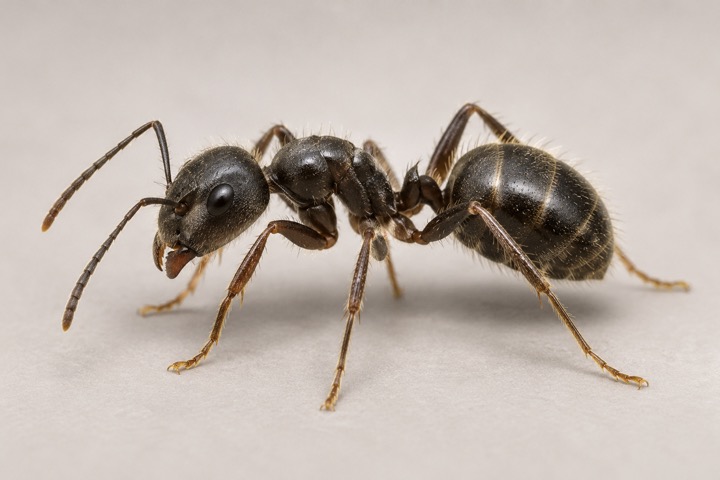
Black garden ants are social insects that live in colonies. Each colony is centred around a queen and the ants most people see are worker ants. These workers are sterile females responsible for gathering food, caring for the young and maintaining the nest.
Black garden ants normally nest outside. Nests are commonly found in soil, beneath paving, around patios and close to building foundations.
Worker ants leave the nest to search for food. Sweet substances, crumbs, spillages, food waste and pet food can all attract them.
When a worker finds a suitable food source it leaves a pheromone trail that other workers can follow. This is why a few ants can quickly become a steady line travelling along the same route.
Seeing ants indoors does not necessarily mean the nest is inside the building.
One common misconception is that there is only one nest involved. In reality, there may be several colonies contributing to the activity being seen in and around a property.
During warm weather, colonies may also produce winged males and queens. These are the flying ants people often notice during the summer. Their purpose is reproduction and establishing new colonies.
How Guardian approaches an ant problem
Our approach follows three practical stages: exclusion, restriction and control.
1. Exclusion
We look at how the ants are entering the building and identify gaps or routes that may be allowing them inside.
Where practical, sealing entry points can help. However, ants can use very small gaps, so proofing alone may not resolve established activity.
2. Restriction
Removing the food source makes the building less attractive to foraging ants.
Keep food sealed, clean up spills promptly and pay particular attention to sugary substances. Bins, pet feeding areas, food cupboards and spaces beneath kitchen units may all need checking.
Cleaning is important, but it may not be enough once ants have established a regular trail into the building.
3. Control
Where treatment is needed, we normally use professional ant gels placed in carefully selected areas.
Worker ants feed on the gel and carry it back towards the colony. This helps target more than just the ants visible on the surface.
We do not normally use residual sprays or insecticidal dusts for black garden ants indoors. A targeted gel treatment avoids unnecessarily treating surrounding surfaces.
What happens when we visit?
The technician will confirm that the activity is consistent with black garden ants and look at where they are feeding and entering.
Where appropriate, a professional ant gel will be applied in small, targeted placements. The technician will explain where it has been applied and what should not be disturbed while the treatment is working.
You may continue to see ants while workers are feeding on the gel and carrying it back towards the colony.
Avoid using household ant sprays around treated areas because this may interfere with the treatment.
After the visit you will receive a report explaining what was found, what was done and any practical recommendations. Domestic customers and one-off jobs receive an electronic report. Planned commercial contracts receive electronic visit reports together with the agreed site records or pest management folder.
Will one visit be enough?
Black garden ant treatments are often completed in a single visit, but some problems need further attention.
We do not guarantee that ants will never return. Treatment addresses the activity and entry routes identified at the time of the visit. Other colonies may already be present nearby and could cause future activity.
If further treatment is recommended, we will explain why and what it involves.
Commercial considerations
Black garden ants can be a concern in food businesses, care settings, hospitality premises and other sites where food is stored, prepared or served.
Although black garden ants are not generally considered dangerous, they can move between waste areas, floors, food preparation areas and packaging. Their presence may also raise hygiene concerns with customers, staff or auditors.
Commercial ant work can normally be discussed and priced over the phone. Prices are plus VAT. We will ask where the ants have been seen, what type of premises is involved and whether food or sensitive areas are affected.
Frequently asked questions
Are black garden ants dangerous?
They are not generally considered dangerous. However, they can contaminate food and surfaces as they move between outdoor areas, waste, floors and food sources.
Should I use an ant spray?
Sprays may kill the ants you can see without dealing with the wider colony. If a gel treatment is being used, avoid applying household sprays around it as this may interfere with the treatment.
Do you treat outdoor ant nests?
No. Black garden ants are widespread outdoors and treating a nest simply because it is present in a lawn, flower bed or patio rarely provides worthwhile long term control. We concentrate on ants entering or affecting the building.
Will one treatment get rid of them?
One visit is often enough, but not always. Success depends on the location of the colony, access, ant activity and whether other colonies are present nearby.
What about flying ants?
Flying ants usually appear during mating flights in warm weather. The activity is normally short lived, so we do not recommend professional treatment for flying ants alone.
If they appear indoors, they can normally be removed with a vacuum cleaner as they emerge.
Can you price the treatment over the phone?
Usually, yes. Tell us where the ants are appearing, whether the property is a home or business and your postcode. We will explain the likely treatment and cost before you decide whether to book. Prices are plus VAT.
Tell us what you have noticed
You do not need to identify the pest before contacting us.
Tell us what you have seen, where the ants are appearing and whether the problem is at your home or business. We will explain the most sensible next step.